Call Us
 Book a Repair
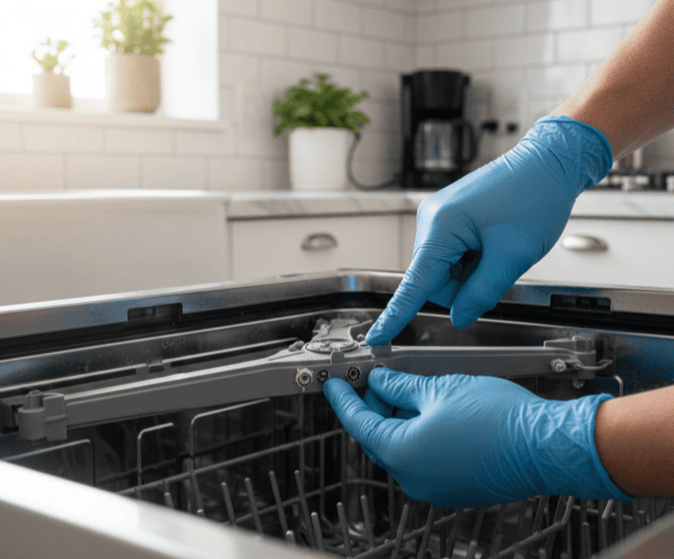

It’s a common frustration: you open the dishwasher expecting sparkling plates, only to find them covered in grit or grease. If your dishwasher is not cleaning properly, it’s usually down to a few usual suspects: a dishwasher filter blocked with food debris, clogged spray arms, or an issue with the water not heating.
At Domex, we’ve been fixing kitchen appliances across London and the South East for over 20 years. We know that in areas like Croydon and Barnet, the local hard water is often the hidden culprit behind poor performance.
Key Takeaways:
- Identify the “Hidden” Cause: Learn why London’s hard water is often the secret culprit behind grit and cloudy film on your dishes.
- Master the DIY “Shake Test”: Discover the simple maintenance trick to clear blocked spray arms without damaging the appliance.
- Decipher Your Error Codes: Understand what your dishwasher is trying to tell you—from E15 leak alerts to i20 drainage failures.
- Know When to Step Back: Distinguish between a simple blockage you can fix at home and mechanical faults that require professional diagnostics.
Why Is My Dishwasher Running But Not Cleaning?
A dishwasher that completes its cycle but leaves a mess is typically suffering from poor water circulation or low temperatures. Common causes include:
- A clogged sump filter.
- Dishwasher spray arms not spinning because they’re blocked by tall plates.
- Limescale build-up in the dishwasher (calcium buildup) choking the spray jets.
- A faulty turbidity sensor ending the wash too early.
Quick Tip: If your dishes feel gritty or cold immediately after a cycle, your heating element or circulation pump might have failed.
The 6 Most Common Reasons
Here’s a quick overview of the most common reasons why your dishwasher may not be working as well as it should:
- Filter blocked: Food, grease or paper labels recirculating onto your “clean” dishes.
- Spray arms clogged: Limescale build-up in the dishwasher or food pips stopping the water flow.
- Loading issues: Large trays blocking the arms from rotating.
- Detergent problems: Damp pods that don’t dissolve or dispensers that stay stuck shut.
- Water not hot enough: If the dishwasher is not heating water, grease simply won’t shift.
- Hard water issues: A chalky film caused by a lack of dishwasher salt and rinse aid.
Safe DIY: How to Clear Blocked Spray Arms
Before calling an engineer, try this simple maintenance check:
- Isolate the Power: Unplug the unit or switch off the fused spur. Never work on a machine that is still live, especially when dealing with water circulation components.
- Remove the arm: Most arms unclip with a light tug or a quarter-turn.
- The “shake test”: If it rattles, debris is trapped inside.
- Clear the jets: If you find the dishwasher spray arms clogged, use a toothpick to gently clear the holes. Do not use a needle, as enlarging the holes will ruin the spray pressure.
- Refit: Click it back and spin it by hand to ensure it clears the heating element.
Justin’s Engineer Note: Check for ‘Seam Splits’
“While you’re cleaning the nozzles, perform a ‘pressure check’ on the arm itself. Modern plastic spray arms are heat-welded. In my 2,000+ repairs, I often find these seams split open due to high-temperature cycles. If that seam has even a hairline crack, the water pressure bleeds out sideways. It’s like a garden hose with a hole in the side—the water will never reach the top rack with enough force to clean your glasses, no matter how clean the nozzles are. If the arm feels ‘flexible’ or you see a gap along the edge, it needs replacing.”
Understanding Dishwasher Error Codes
If your machine is flashing lights or displaying a code, it’s trying to tell you where it hurts.
| Code (Common Examples) | Typical Meaning | What to do next |
|---|---|---|
| E15 – Bosch, Neff, and Siemens / i30 – AEG, Electrolux, and Zanussi | Leak / flood protection triggered | Switch off, check for water underneath. |
| F70 Miele / E01 Beko | Internal Leak (Flooded Base) | The internal anti-flood float switch is active. Requires tilting to clear or a pump inspection. |
| i20 / OE | Drainage issue | Check for a dishwasher filter blocked or a kinked hose. |
| Heating Codes (e.g. Bosch E09) | Water not heating | Usually requires an engineer to test the heater/NTC thermistor for continuity. |
Can’t clear the error code? Some faults require internal testing with multimeters and specialised tools. Book an expert diagnostic or call Domex on 0330 210 2100 for same-day dishwasher repair.
The Domex Diagnostic: Professional Repairs
When DIY isn’t enough, our manufacturer-trained engineers use specialised tools like multimeters to test heater resistance and IR thermometers to verify water temperatures. We don’t just guess, we find the root cause.
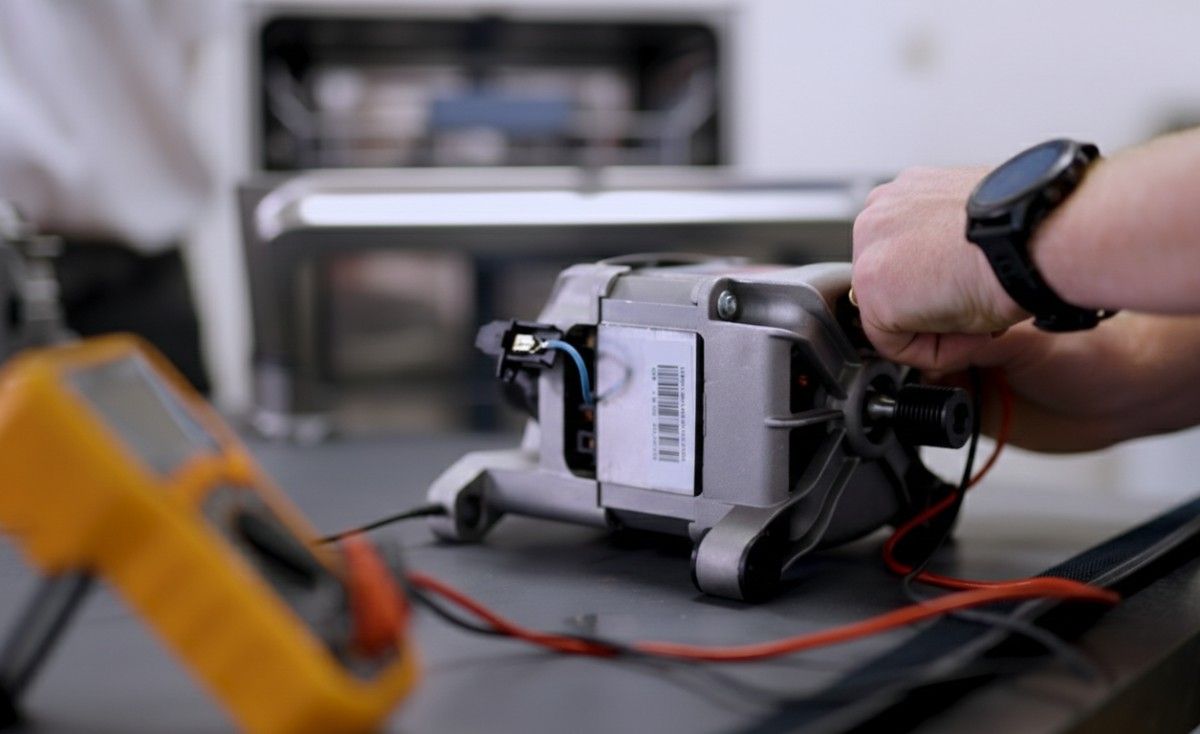
The 5-Minute Engineer Check:
“If your dishes are coming out wet and greasy, it’s often a thermal fault. Before you call us, check if the water is actually heating. A faulty NTC (Negative Temperature Coefficient) sensor can ‘drift,’ incorrectly telling the control board the water is hot when it’s cold. I use a multimeter to check the NTC—you’re looking for a resistance of roughly 50kΩ at 20°C. If it’s wide open or shorted, the machine will never trigger a proper degreasing wash.”

When to stop DIY and call us:
- You smell burning or the electrics trip.
- There is a persistent, loud dishwasher circulation pump noise.
- You see dishwasher error codes (E15 / i30 / i20) repeatedly.
Read More:
LG Dishwasher Error Codes
Miele Dishwasher Fault Codes
Samsung Dishwasher Troubleshooting Codes
Whirlpool Dishwasher Error Codes - The water stays cold even on a “pro-wash” or “intensive” cycle.
Book Your Repair Today
Domex’s team of over 70 DBS-checked, manufacturer-trained engineers provides same-day repairs across London, the South East, and the Midlands, fully backed by a 12-month guarantee on all parts and labour.
Manufacturer support: Bosch, Hotpoint, Whirlpool, Samsung, LG and many more.

FAQs
Why does my dishwasher leave a gritty residue on top-rack glasses?
This is usually ‘recirculation’ of food soil. It happens when the fine mesh filter at the bottom is slightly torn or not locked into place. Small particles (like coffee grounds or pips) bypass the filter, enter the wash pump, and get sprayed back onto the upturned glasses. Check the filter for any tiny holes or a loose “click-lock.”
My dishwasher runs for hours but the dishes are still dirty—why?
This is often the Turbidity Sensor (the machine’s ‘optical eye’). This sensor measures how cloudy the water is to decide if it needs more rinsing. If the lens is coated in a film of grease or limescale, it ‘sees’ dirty water forever and keeps the cycle running in a loop, or it gets ‘blinded’ and ends the cycle prematurely. A quick wipe of the internal sensor lens with a damp cloth can sometimes fix this.
What does it mean if my dishes are dirty but the tablet hasn’t dissolved?
First, ensure a tall plate isn’t blocking the detergent dispenser flap. If the flap is clear, the issue is likely Thermal Logic. If the NTC sensor or the heating element (which should read about 25-28 Ohms on a multimeter) fails, the water stays cold. Standard dishwasher tablets are designed to dissolve at 40°C+; in cold water, they simply sit in the dispenser or fall out in a clump.
Is it safe to use a multimeter to test my dishwasher at home?
Only if the machine is completely isolated from the power. Unplug it or switch off the fused spur. We use multimeters to test the solenoid valves and heaters for continuity. If you aren’t comfortable checking ‘Ohms’ or ‘Resistance,’ this is where you should step back. Our Domex engineers are DBS-checked and manufacturer-trained to handle these electrical tests safely.
What are the three most important rules when using a dishwasher?
- Load so spray arms can spin and water can reach every surface.
- Keep the filter clean (it’s the dishwasher’s “trap” for bits).
- Use fresh detergent and rinse aid (and salt if your model needs it), especially in hard-water areas.
Certified Logic:
“Simply filling the salt reservoir isn’t enough if your machine isn’t calibrated to your local water grid. In London and the South East, we often see hardness levels above 280ppm. You need to use the settings menu (usually a combination of the ‘Program’ and ‘Start’ buttons) to set the internal ion-exchange resin softener to the correct level. If this is set too low for your area, you’ll get that classic white limescale film even with a full salt pot.”
What’s the average dishwasher lifespan?
Many dishwashers last around a decade in normal home use, but lifespan varies based on water hardness, maintenance and how heavily it’s used. Regular filter cleaning and monthly maintenance cycles help, particularly in hard-water areas.
What are signs of a failing dishwasher?
Repeated poor cleaning after basic maintenance, recurring leak/drain errors, grinding pump noises, persistent lukewarm cycles and water left in the base are all signs the dishwasher needs professional diagnosis.
Can you just throw a dishwasher pod into the dishwasher?
Some people do, but most manufacturers still expect pods to go in the detergent dispenser so they release at the right time in the cycle. If the dispenser is jammed (often by a large plate or utensil), the pod may dissolve too early or not at all, leading to poor cleaning. If you suspect the dispenser isn’t opening, fix the loading first, then test again.
Is it OK to put vinegar in the dishwasher?
White vinegar can help with mild odours and light scale, but don’t overdo it. Repeated strong acid use isn’t great for some seals over time. A safer long-term approach is a manufacturer-approved dishwasher cleaner/descaler. And never mix vinegar with bleach or other cleaners.
Can you put vinegar and baking soda in the dishwasher at the same time?
This is not recommended. They react and cancel each other out, and you don’t get consistent results. If you’re cleaning, do one method at a time, on an empty hot cycle, following safe quantities.
Why is there food residue left on dishes?
Dishwashers leaving bits on dishes usually means the filter isn’t trapping debris or the spray arms aren’t pushing enough water to flush the food away. If you hear a strange dishwasher circulation pump noise (like grinding or humming), something might be stuck in the impeller.
Why is there sediment or “sand” on my glasses?
This “gritty” sediment is often mineral build-up breaking loose. In London and the South East, the water is notoriously hard. Unless you keep your dishwasher salt and rinse aid topped up, you’ll likely see a dusty film or cloudy spots on your glassware.
What should I do if I live in a hard-water area?
Keep your rinse aid topped up If your dishwasher uses a softener, keep salt topped up and set hardness correctly (see your manual). Run a monthly maintenance cycle with a proper cleaner/descaler. If you’re repeatedly clearing jets and cleaning filters, consider an engineer check for heat rise and fill level.