
 Call Us
 Book a Repair

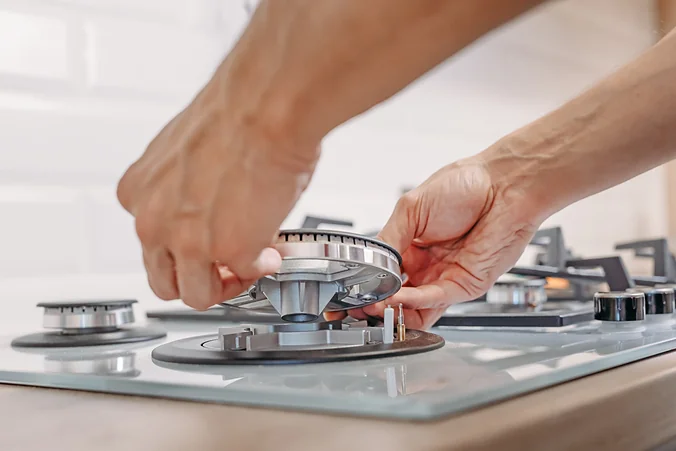

A gas safety inspection on a cooker checks that the appliance burns cleanly and holds gas without leaking. It also confirms the cooker shuts off automatically if the flame fails.
A Gas Safe registered engineer tests pressure and flame supervision and looks at the surrounding ventilation. Only then do they confirm if the hob or oven is safe to keep using.
We see this check as the difference between an appliance that looks fine and one that actually is.
If your gas hob has started acting oddly, or you simply want to know what happens during a gas safety inspection, this guide is for you.
I answer the questions homeowners and landlords ask us most often, from spotting an unsafe flame to understanding who is legally allowed to disconnect a cooker.
Key Takeaways
- A yellow or orange flame, soot staining or a popping sound when lighting all mean the cooker needs a Gas Safe engineer before it is used again.
- If you smell gas or your carbon monoxide alarm sounds, turn off the supply at the meter, open windows and call the National Gas Emergency Service on 0800 111 999.
- A flame supervision device cuts the gas within seconds if a flame goes out. But it is a backup and not a substitute for regular checks.
- Landlords must have every gas appliance checked annually and give tenants a copy of the CP12 certificate within the legal timeframe.
- Fitting, disconnecting or repairing a gas cooker is never a DIY job. Only a Gas Safe registered engineer may legally carry it out.
Gas Cooker Safety Checks at Home: The Essentials
At Domex, we treat gas cooker safety checks as one of the simplest ways to catch a fault before it turns into an emergency.
Poor combustion or a slow leak can develop in a hob or oven long before any obvious symptom shows up. And a partially blocked vent can stay hidden for just as long.
By the time a flame turns yellow or the kitchen smells faintly of gas, the appliance may have been running unsafely for some time.
That is why we have built this guide around the problems people notice first:
- Warning signs
- The safety devices fitted inside a modern cooker
- What the law demands
- The everyday habits that keep an appliance safe between checks
In the sections below, I point out where a professional repair can put right a fault that a safety check has uncovered, rather than leaving a household to live with an appliance that only appears to be working.
Our cooker repair service covers exactly this kind of work, and a Gas Safe registered engineer should always be your first call the moment the appliance looks or sounds wrong, and certainly if it smells of gas.
What Is a Gas Hob?
A gas hob is the cooktop surface in a kitchen that burns natural gas or LPG through a set of burners, rather than heating a pan with electricity.
Each burner has its own control valve and an ignition system. This is usually a piezo spark or an electronic ignition that lights the gas as soon as the knob is turned.
A hob only provides surface cooking, whereas an oven encloses the heat for baking and roasting. A range cooker combines the two in a single freestanding unit.
For faults on the oven itself, our oven repair service covers the enclosed cooking side of the kitchen, too.
Whatever the configuration, a gas hob depends on a continuous, correctly pressured gas supply reaching every burner jet, because even a small drop in pressure can turn the flame from a sharp blue cone into something less efficient and less safe.
Signs Your Gas Cooker Is Unsafe
A gas cooker tells you something is wrong long before it fails completely.
The clearest warning is a flame that has turned yellow or orange instead of burning a crisp, steady blue.
That colour change usually points to incomplete combustion, often linked to a dirty burner or restricted air supply, and it should never be ignored.
Other signs are easy to miss if you are not looking for them.
- Soot or dark staining: marks around the burner heads, on the bottom of your cookware or on the wall behind the cooker suggest the gas is not burning cleanly.
- Popping or banging when lighting: a popping or banging noise when you light a burner can mean the ignition is struggling against the wrong gas-to-air mix.
- Heavy condensation: unusually heavy condensation on kitchen windows, especially during cooking, can also point to a ventilation or combustion problem rather than simply a steamy pan.
- Damaged hose, connector or knob: a damaged flexible hose or a loose connector at the back of the cooker is a mechanical fault that needs attention regardless of how the flame looks. So is a cracked knob.
“We always tell customers that a cooker rarely fails without warning. The flame colour and the sound it makes when it lights are two of the easiest things anyone can check for themselves before calling an engineer,” says Nick, one of our Domex experts.

If you notice any of these signs, stop using the appliance right away and arrange for a Gas Safe registered Domex engineer to inspect it before you cook with it again.
Carrying on with a cooker that shows one of these symptoms is rarely worth the risk.
Why Does My Gas Cooker Smell of Gas?
A gas smell from your cooker usually means gas is escaping somewhere it shouldn’t.
A loose connection or a damaged hose may be to blame. And so might a valve that has not closed fully. Either way, it needs an immediate response rather than a wait-and-see approach.
First, turn off the gas supply at the meter, if you can do so safely. Do not operate any light switches, and avoid lighting a match or using anything with a naked flame because a spark could ignite escaping gas.
Open windows and doors to let the gas disperse. If the smell is strong or you feel unwell, leave the property straight away rather than staying.
Once you are safely outside, call the National Gas Emergency Service on 0800 111 999. This free, 24-hour line will talk you through next steps and can dispatch an engineer to make the situation safe.
Only after the immediate danger has been dealt with should you arrange a Gas Safe registered engineer to find and fix the underlying fault.
That might turn out to be a worn hose or a faulty valve, and sometimes the cooker needs replacing altogether.
Our repair or replace guide can help you reach a more informed decision.
IMPORTANT NOTE: Treat a gas smell as an emergency every time, even if it fades quickly, because an intermittent leak can still build up to a dangerous concentration.
No Gas Coming Out of the Hob: Causes and Fixes
When no gas reaches a hob burner, the cause is usually something straightforward. And working through the likely culprits in order will often pin down the problem before you need to call anyone.
Start with the obvious things like the following:
- Check that the supply valve behind the cooker or at the meter has not been left closed, perhaps after other work in the kitchen.
- Next, consider whether a safety cut-off has tripped, which can happen after a sudden pressure change or a previous leak detection event.
If none of these explain the fault, blocked burner jets are a strong possibility, especially if the cooker has not been cleaned thoroughly for some time, as spilled food and grease can physically obstruct the small ports that release gas.
Resetting a cut-off once is reasonable troubleshooting. But if the burner keeps failing to ignite, or the pilot will not stay lit no matter how many times you try, that pattern points to an underlying fault.
Repeated DIY resets can mask a genuine safety issue, so at that point it is time to book a professional repair instead of trying again.
Explaining the Gas Cooker Safety Cut-off Device
A gas cooker’s safety cut-off device, also called a flame supervision device, is the small thermocouple-based mechanism that keeps the burner’s gas valve open only while a flame is actually burning.
The thermocouple sits in the flame and generates a tiny electrical signal from the heat it senses. And that signal is what holds the gas valve open.
If the flame goes out, perhaps because of a draught or a boil-over, the thermocouple cools almost immediately and the signal stops.
A knock to the control can have the same effect. Within a matter of seconds the valve closes and gas supply to that burner is cut off, so unburned gas cannot keep flowing into the room.
This is one of the most important built-in protections a modern cooker has. And it works entirely automatically with no input needed from the user.
Many hobs also include auto-ignition, which relights a burner electronically the moment the knob is turned, so there is no need for a separate spark or match.
Portable gas appliances often add an anti-tilt valve as well. It shuts off the gas supply automatically if the unit is knocked over. And that reduces the fire risk from an unattended flame.
IMPORTANT NOTE: None of these devices replace the need for a proper gas safety inspection, since a cut-off device can itself fail or wear out over time.
Carbon Monoxide Risks from Gas Cookers
Carbon monoxide from a faulty gas cooker is dangerous precisely because you cannot see it and because it gives off no smell or taste. It builds up silently whenever gas burns incompletely.
This incomplete combustion is the same underlying process behind the yellow or orange flames covered earlier, which is why that warning sign matters so much.
Exposure to carbon monoxide can cause a cluster of symptoms that are easy to mistake for a cold or simple tiredness. Headaches, dizziness, nausea and breathlessness are the most commonly reported effects.
They often ease once the person leaves the room or the house, which is itself a useful clue that the air inside is the problem.
At higher concentrations, the effects become far more serious, so any symptom pattern that improves away from home deserves urgent attention rather than being brushed off.
IMPORTANT NOTE: We recommend fitting an audible carbon monoxide alarm near your gas cooker and any other gas appliances in your home and following the alarm manufacturer’s placement guidance when you do.
Test it monthly, and replace the unit before its stated expiry date rather than waiting for it to fail.
An alarm adds a vital extra layer of protection on top of the annual safety check and the two work best together.
Gas Cooker Ventilation Requirements at Home
Gas cookers need a steady supply of fresh air to burn cleanly, and UK regulation sets out exactly how much ventilation a kitchen should provide.
The Gas Safety (Installation and Use) Regulations 1998 require appliances to be used only in rooms with adequate ventilation. Meanwhile, the Building Regulations Approved Document J and the technical standard BS 5440-2 go further by specifying how that ventilation should be achieved, depending on room size and appliance output.
In general terms, a smaller kitchen needs more deliberate ventilation than a larger one because a bigger room can naturally hold and exchange more air around a burning appliance.
| Kitchen size | Ventilation generally needed | Typical solution |
|---|---|---|
| Very small kitchen | Permanent ventilation or mechanical extraction is usually required | Fixed air brick, wall vent or extractor fan |
| Medium-sized kitchen | A permanent ventilation opening is normally expected | Fixed grille or trickle vent in a window |
| Larger, well-sized kitchen | Natural air exchange is often sufficient | Openable window plus general room volume |
Where a permanent opening is not practical, such as in a windowless or heavily insulated kitchen, mechanical extraction becomes necessary, and any ducted extractor should vent directly to the outside rather than simply recirculating air through a filter.
Blocking an existing vent starves the burners of the oxygen they need and pushes combustion gases back into the room instead of letting them disperse.
Furniture placed in front of a vent can do this, as can a sealed window. Even a well-meaning draught excluder has the same effect.
Portable Gas Cooker Safety Precautions
A portable gas cooker or camping stove carries its own set of risks because it is designed to move between locations rather than sit on a fixed, ventilated supply.
Use it only in a well-ventilated area, and never run one indoors without a reliable source of fresh air, since the combustion gases it produces have nowhere safe to go in a sealed room.
“Portable units get far less attention than a fitted cooker, but the basic safety logic is identical. Check the canister seal every time, not just when something seems wrong,” according to Nick.
Before each use, check the canister seal and the connection point for damage or wear, as a worn seal is a common source of leaks on portable units.
Keep the stove stable on a flat, heat-resistant surface well away from flammable materials such as curtains or paper.
Spare gas canisters belong somewhere cool and out of direct sunlight and they should be kept away from the appliance itself when not in use.
Buying a Gas Cooker: What to Check First
Before buying a gas cooker, confirm it matches the fuel type already supplied to your home, since natural gas and LPG appliances use different jets and are not interchangeable without conversion by a qualified engineer.
If you get this wrong, you’ll end up with a cooker that either will not run safely or will not run at all once it reaches your kitchen.
Next, think about which suits your layout better: a freestanding cooker or a separate built-in hob and oven.
A freestanding unit is often simpler to swap like-for-like, while a separate hob and oven combination gives more flexibility over kitchen design, particularly where worktop space or cabinetry has already been fitted.
Our cooker buying guide walks through this choice in more depth if you are still deciding between the two.
Read the small print on any “free fitting” offer carefully before you assume it covers everything. Basic connection to an existing, suitable gas point is usually what is included. Removal of your old appliance is often charged as an extra, and the same goes for a new bayonet adaptor or a cooker point safety test.
Ask the retailer exactly what the free fitting includes before you commit and you will avoid a surprise on delivery day.
How to Fit a Gas Hob Safely and Legally
IMPORTANT NOTE: Fitting a gas hob is not something you can legally do yourself, no matter how straightforward the instructions look.
Under the Gas Safety (Installation and Use) Regulations 1998, only a Gas Safe registered engineer may connect a gas appliance to the supply. And this applies equally to a simple replacement and a brand-new installation.
Most freestanding cookers connect using a flexible bayonet fitting, which allows the appliance to be pulled forward for cleaning without disconnecting the gas supply each time.
Bayonet connectors are covered by their own fitting regulations to ensure the coupling seals correctly and cannot be pulled apart accidentally, and an engineer will check the fitting matches the appliance and the room it serves.
For cooker installations handled alongside a kitchen refit, our cooker and oven installation service covers both the gas connection and the surrounding setup.
Once the hob is connected, the engineer must carry out a tightness test to confirm there are no leaks anywhere in the new joint or the surrounding pipework.
This post-installation check is the step that actually proves the connection is safe before the cooker is handed back to you for everyday use, so it should never be treated as optional paperwork.
Removal of a Gas Cooker: Who Can Disconnect It?
IMPORTANT NOTE: Only a Gas Safe registered engineer can legally disconnect a gas cooker from the supply, even for what seems like a simple swap between two similar appliances.
The real danger lies in an improperly capped pipe left behind, which can leak gas into the room long after the old appliance has been carried out of the house.
A safe removal follows a clear sequence:
- The engineer first isolates the gas supply at the appropriate valve and disconnects the appliance.
- The open pipework is then capped securely so no gas can escape even if the supply is accidentally turned back on.
- Only once that pipe is safely capped is the old cooker free to be moved and disposed of responsibly, usually through a licensed waste carrier rather than simply left on the pavement.
Skipping this process, or asking someone without Gas Safe registration to handle it, leaves an invisible hazard in the wall long after the job looks finished.
It is a short piece of work for a qualified engineer, which makes it one of the easiest safety steps to simply book rather than attempt alone.
Are Gas Cookers Being Phased Out?
Gas cookers are not currently being phased out in the UK, and the policy changes making headlines target gas boilers and central heating systems rather than hobs or ovens.
Current government plans, set out through the Future Homes Standard, affect new-build properties and their heating systems, with changes for new homes in England not taking effect until 24 March 2027.
In January 2026, the government’s Warm Homes Plan dropped an earlier proposed 2035 deadline for existing properties entirely, which means there is no forced timetable requiring any household to remove a working gas appliance.
Some homeowners are showing growing interest in induction cooking, partly driven by efficiency and partly by kitchen design trends, but that shift is a matter of personal choice rather than regulation.
Gas cookers remain legal to use and install for the foreseeable future. They can still be repaired, provided they are properly maintained and checked.
How Do I Know If My Gas Cooker Is Safe?
Beyond the annual inspection, a handful of everyday habits go a long way towards keeping a gas cooker safe between visits from an engineer.
Never use the cooker or hob to heat a room, even briefly during a cold snap, because gas appliances are designed to burn in open contact with cookware and were never meant to warm an enclosed space.
“The households that stay safest are the ones that treat small habits as routine. Turning pan handles inward and keeping the area around the hob clear takes seconds, but it removes two of the most common accident risks we see,” according to Nick.
- Keep vents clear: never block an air brick or trickle vent, and keep the extractor fan free too, as they supply the oxygen a burner needs.
- Turn handles inward: this reduces the chance of a pan being knocked and spilling onto a burner or the floor.
- Clear the surrounding area: keep tea towels and packaging away from the hob while it is in use, along with any other clutter.
- Test alarms regularly: check smoke and carbon monoxide alarms on a set schedule rather than waiting for them to chirp a low-battery warning.
Booking the annual gas safety check into your diary each year, rather than waiting until something feels wrong, is the single most reliable habit of all.
For households that want extra reassurance, an ongoing repair and maintenance plan means a developing fault gets caught and fixed quickly instead of being left to worsen into something more serious and more expensive.
Keeping a gas cooker safe usually comes down to several small decisions rather than one big one, from recognising an odd flame colour to booking the next inspection before the last certificate expires.
A little vigilance, backed by a Gas Safe registered engineer when something needs more than watching, keeps a kitchen running exactly as it should.
Frequently Asked Questions
How often should a gas cooker be checked?
There is no single fixed legal interval for homeowners, but checking it alongside an annual boiler service is a sensible and easy routine to keep.
Can I service my own gas cooker?
No. Any work on a gas appliance must be carried out by a Gas Safe registered engineer, though you can safely keep the area around it clean and clear.
What should I do if a burner won’t stay lit?
Try relighting it once following the manufacturer’s instructions, but if it keeps going out, treat that as a fault needing a professional repair rather than repeated resets.
Is it illegal to fit a gas cooker myself?
Yes. Connecting, disconnecting or moving a gas cooker’s supply is controlled work under the Gas Safety (Installation and Use) Regulations 1998 and must be done by a Gas Safe registered engineer.
