Call Us
 Book a Repair


At a glance: Venko’s diagnostic summary
If you’re in a rush, here is the “engineer’s shorthand” for what you’ll find in this guide:
- The name game: On Samsung screens, 5E and SE are the same thing: a drainage failure.
- First fix: Try a hard reset (drain residual power) and calibration mode before buying parts.
- The “impeller” test: A healthy pump should feel “springy” when flicked. If it spins freely, it’s broken.
- The hidden fault: Often, a jammed pump blows a tiny electronic switch (triac) on the main PCB, which is hidden under silicone gel.
- Repair vs. replace: If your drum has grey streaks on the seal, the bearings are gone and it’s time for a new machine.
You’ve reached the end of a long laundry day, but instead of the usual “end of cycle” chime, your Samsung washing machine is sitting there sullenly with a drum full of grey, soapy water. On the screen, two characters are flashing: 5E.
Most people reach for the manual, see “drainage fault,” and head straight for the filter. They clean it, twist it back in, and start a new cycle only for the same 5E (or what looks like SE) to reappear 10 minutes later.
I’m Venko, a senior engineer with over 14,500 repairs under my belt. In my experience servicing South West London and Twickenham, the 5E error is one of the most misunderstood codes in the Samsung ecosystem. Today, I’m going to take you beyond the basic manual and show you what’s actually happening inside your machine.
Before we start: Safety first
Venko’s rule: Before you open any panels or reach into the machine, unplug it from the wall. If the drum is full of water, remember that water and electricity are a lethal combination. Have a shallow tray and plenty of towels ready. Once you open that filter, the “emergency” drain tube is your best friend to avoid a flooded kitchen.
1. The Confusion: Is it 5E, SE or E5?
On many Samsung digital displays, the letter ‘S’ and the number ‘5’ look identical. This leads to thousands of people searching for an “SE” error that doesn’t technically exist in the handbook.
- 5E/SE: These are the same. It means the water isn’t leaving the drum fast enough (usually within 10 minutes).
- E5: This is different. It usually points to a heating, drain or NTC sensor fault.
- 5C: On newer EcoBubble models, 5C is the modern version of 5E.
What the official Samsung manual says:
Before we get our hands dirty, it helps to know exactly what the manufacturer’s engineers list as the root causes for a 5E/SE Drain Error. According to Samsung’s internal diagnostic tables, the machine will throw this code due to:
- Physical blockages: The drain hose or internal pathways are clogged with foreign material or debris.
- Pump obstructions: The water pump terminal is disconnected or jammed by pocket items (the manual specifically warns about rubber bands, paper bills, cotton, hairpins, and coins).
- Mechanical failure: The pump motor impeller has sustained internal damage or there is a general part fault in the drainage system.
- Electrical/power issues: The wrong voltage is reaching the parts (e.g., 110V instead of 220V), or there are wider household power supply issues.
- Environmental factors: The water inside the drain system has frozen during the winter season.
Knowing the official list is great, but how does that translate to your kitchen? Let’s look at the real-world fixes.
2. Basic Checks
Before we talk about circuit boards, check the basics I see in the field every day:
The coin trap:
Bottom right of your machine. Unscrew it and look for hairpins, coins or those tiny “colour catcher” sheets.

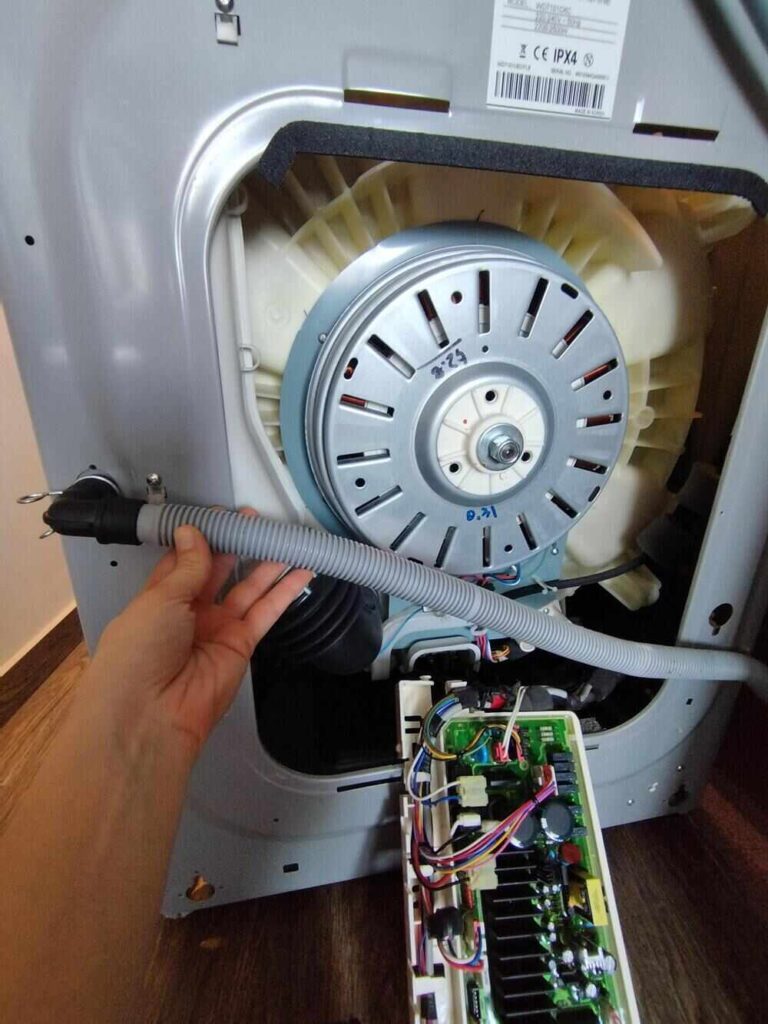
The kinked hose:
If you’ve recently pushed your machine back into its housing, you might have pinched the grey corrugated drain hose.
The sink spigot:
If you’ve just moved house, check that the plastic “blanking plug” inside the sink’s under-counter pipe has been removed.
Struggling to clear a stubborn blockage? Don’t risk a flooded kitchen.
Our engineers carry specialized wet-vacs and drain-clearing tools to resolve 5E errors on the first visit.
Book a Fixed-Price Samsung Diagnostic Now
3. Step 0: The Samsung “hard reset” and calibration
Sometimes the 5E code is a “ghost” in the machine also referred to as a logic error caused by a power surge.
- The power cycle: Unplug the machine and hold the Start/Pause button down for a full 5 seconds. This drains the residual energy from the capacitors on the control board. Plug it back in.
- The calibration run: If you have an EcoBubble model, hold Temp and Delay End simultaneously for 3 seconds. It forces the machine to re-level itself and can sometimes clear “stuck” logic loops.
4. Testing the Drain Pump Mechanically
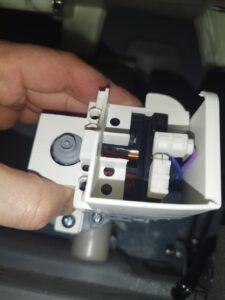
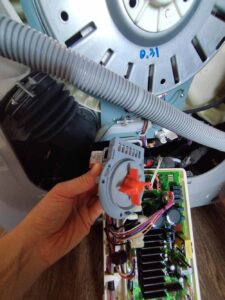
If the filter is clean and the reset didn’t work, we need to look at the pump itself.
Venko’s field note: “When I arrive at a call-out, I don’t just look at the pump; I feel it. With the filter removed, I reach in and flick the plastic impeller (the fan blades). A healthy magnetic pump should have a ‘springy’ resistance. It should jump 90 degrees as you flick it. If it spins freely like a desk fan, the internal coupling has snapped. You’ll hear the motor humming, but the blades aren’t moving any water.”
5. PCB Damage Under the Silicone
This is where generic advice ends. Samsung boards are encased in a thick, jelly-like silicone gel to protect against moisture.
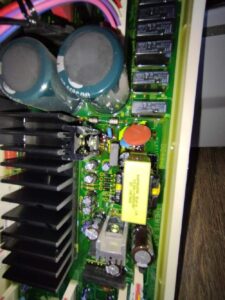
If your drain pump has suffered a “dead short” (maybe from a coin jamming it), it can send a high-current spike back to the brain of the machine. I use a high-lumen torch to inspect the board through the clear gel, looking for a tiny triac (an electronic switch) that has a brown scorch mark. If the Triac is blown, a new pump won’t fix your machine. Instead, I’ll need to carry out repairs on the PCB. But since this fault is very challenging, time consuming and not cost effective, that’s why I usually replace it.
6. Repair vs. Replace: Making the Right Call
Venko’s advice: “I always look at the door seal. If I see grey streaks or ‘glitter’ on the rubber, that’s a sign the inner drum is rubbing against the outer tub because the bearings have failed. Many newer Samsungs use a sealed outer tub, meaning you have to replace the whole drum assembly, which is nearly the cost of a new machine. If your bearings are fine, the 5E fault is almost always worth repairing.”
Why DIY Can Be a Costly Gamble
While clearing a filter is a great DIY task, poking around the PCB or testing live voltages with a multimeter is where I urge caution. Samsung’s silicone gel is incredibly delicate. If you try to scrape it off with a screwdriver, you risk severing the microscopic copper tracks underneath.
Need an expert in South West London?
Venko and our team of senior engineers specialise in Samsung EcoBubble and AddWash repairs across Twickenham, Richmond and beyond.
We provide a 12-month guarantee on all parts and labour.
Schedule Your Samsung Repair – Check Availability Today
Technical disclaimer: While Error 5E is a reliable indicator of a drainage fault, the underlying cause can range from a simple blockage to a complex electronic failure. Due to the high voltages involved and the delicate nature of the PCB’s silicone coating, we always recommend professional diagnostics.